Blog›Guides

The Lighting Words AI Image Prompts Actually Use

We counted 24 lighting terms across 62,558 image and video prompts. Cinematic lighting is everywhere, Rembrandt lighting almost nowhere. Here is the vocabulary, the best prompts for each term and a recipe to make your lighting specific.
The Lighting Words AI Image Prompts Actually Use

The Lighting Words AI Image Prompts Actually Use

Lighting is the part of a prompt that most often separates a flat render from a photograph. We searched the 62,558 indexable image and video prompts on Wikiprompt for 24 common lighting terms and counted how often each one shows up. The result is a map of the vocabulary prompt writers really use, and of the precise terms almost nobody uses yet.

What the corpus shows

The seven most common lighting terms, by number of prompts that contain them:

  • cinematic lighting - 4,423 prompts (about 7% of all image and video prompts)
  • studio lighting - 4,247
  • neon - 4,192 (light sources and signage both count here)
  • rim light - 3,557
  • volumetric light or fog - 2,927
  • natural light - 2,732
  • golden hour - 2,618
  • Next come soft light and overcast (1,206 each), chiaroscuro (759), softbox (490) and moonlight (413). At the bottom are the classic named portrait setups. Rembrandt lighting appears in 56 prompts, split lighting in 47, high-key in 39, low-key in 35 and butterfly lighting in just 13.

    So the vague label "cinematic lighting" is about 80 times more common than "Rembrandt lighting", even though the second one tells the model exactly where the light and the shadow go.

    Generic labels vs named setups

    "Cinematic lighting" and "studio lighting" work as mood words. They push the model toward contrast and polish, but they leave the direction, the softness and the color of the light to chance. Named setups from photography are instructions:

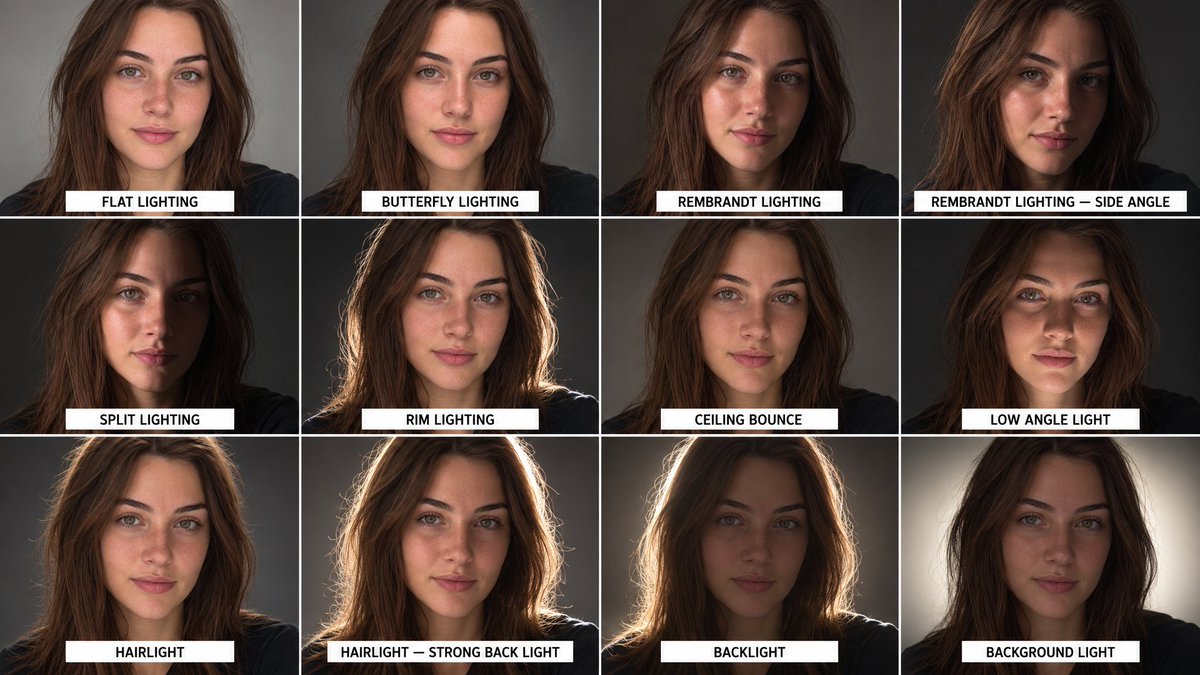
  • Rembrandt lighting: key light at about 45 degrees, a small triangle of light on the shadow-side cheek.
  • Split lighting: half the face lit, half in shadow. Strong and dramatic.
  • Butterfly lighting: key light above and in front, a small shadow under the nose. The classic beauty look.
  • [Rim lighting](/wiki/rim-lighting) and [backlighting](/wiki/backlighting): light from behind that outlines the subject and separates it from the background.
  • [Three-point lighting](/wiki/three-point-lighting): key, fill and back light. The default of studio portraits and film.
  • A mood word plus one concrete setup gives the model both the feeling and the geometry.

    The terms, with the strongest prompts for each

    Studio and portrait light

  • 12-Panel Portrait Lighting Reference Sheet - one image that shows a dozen named setups side by side. It is the most useful single reference for this vocabulary.
  • Classical Portrait Prompt for Gemini Nano - Rembrandt-style light on a painterly portrait.
  • AAA-quality 3D character reference sheet from a photo - clean studio lighting used for readability, not drama.
  • Viking Warrior in Polar Night Low-Key Polarisation Study - softbox plus low-key, almost everything in shadow.
  • Contrast and shadow

  • Fine Art Cinematic Portrait: Lindbergh Meets Bacon - chiaroscuro as the whole concept.
  • Neo-Noir Ink Engraving Portrait Prompt - the same contrast logic, translated to line art.
  • Time of day

  • 1990s French Chateau Garden Analog Wedding Scene - golden hour with an analog film look.
  • Art-house Double Exposure Movie Poster - golden hour used for a warm graphic poster.
  • After-the-rain school rooftop cinematic portrait - blue hour, the cooler twin of golden hour (only 207 prompts use it).
  • Giant Monster Energy Can as Arctic Monolith - overcast light, flat and even, for a product shot.
  • Atmosphere

  • Heavenly Palace Amid the Cloud Sea Epic Fantasy Concept Poster - volumetric light and rim light together. It ranks first for both.
  • Surreal 3D Book-to-Reality Tractor Scene - god rays for a storybook mood.
  • 3D Isometric Travel Poster of a Location - volumetric haze on a miniature scene.
  • Color and practical sources

  • [5 collectible automotive poster for the [CAR NAME]](/5-collectible-automotive-poster-for-the-car-name) - neon as the main color source, as a reusable template.
  • Cinematic Sprite Can in Surreal Forest - bioluminescent light around a product.
  • Kimono Portrait in Moonlit Japanese Room - moonlight plus candlelight, two sources of different color.
  • Which models get these words most

    GPT Image 2 is the most frequent model in almost every lighting term, followed by Nano Banana. That mostly reflects the size of their share in the catalog. Two exceptions stand out:

  • Volumetric light and god rays are disproportionately common in Seedance 2.0 video prompts. Moving light through fog or dust is a video-native effect.
  • Bioluminescent is the one term where Midjourney beats GPT Image 2, which matches its fantasy and concept-art audience.
  • A starter recipe

    Take any prompt that says "cinematic lighting" and make it specific in three slots:

    [subject], [named setup: Rembrandt / split / butterfly / rim light],

    [time or source: golden hour / blue hour / overcast / neon sign / candlelight],

    [quality of light: soft light / hard light, volumetric haze], [color: warm key, cool fill]

    For example: "portrait of an old fisherman, Rembrandt lighting, overcast window light, soft light, warm key and cool fill, 85mm". Each slot removes one decision the model would otherwise guess.

    Explore more

  • Browse portrait prompts with Nano Banana or GPT Image 2.
  • Read the AI Wiki entries on soft light, hard light, bokeh and portrait photography.
  • More on the craft: How to write prompts for cinematic portraits and How to write prompts for realistic AI photos.
  • Tags
    lighting·golden-hour·chiaroscuro·rim-light·portrait·photography·image-generation·prompt-analysis·guide

    Related Articles